
Totally Endoscopic Cardiac Surgery (TECS)
Totally Endoscopic Cardiac Surgery (TECS) is a highly specialized minimally invasive option that allows surgeons to perform complex heart procedures through small incisions using high-definition visualization and precision instruments. It is considered the most anatomically sparing approach to heart surgery available today.
Open Heart Surgery Through a Closed Chest
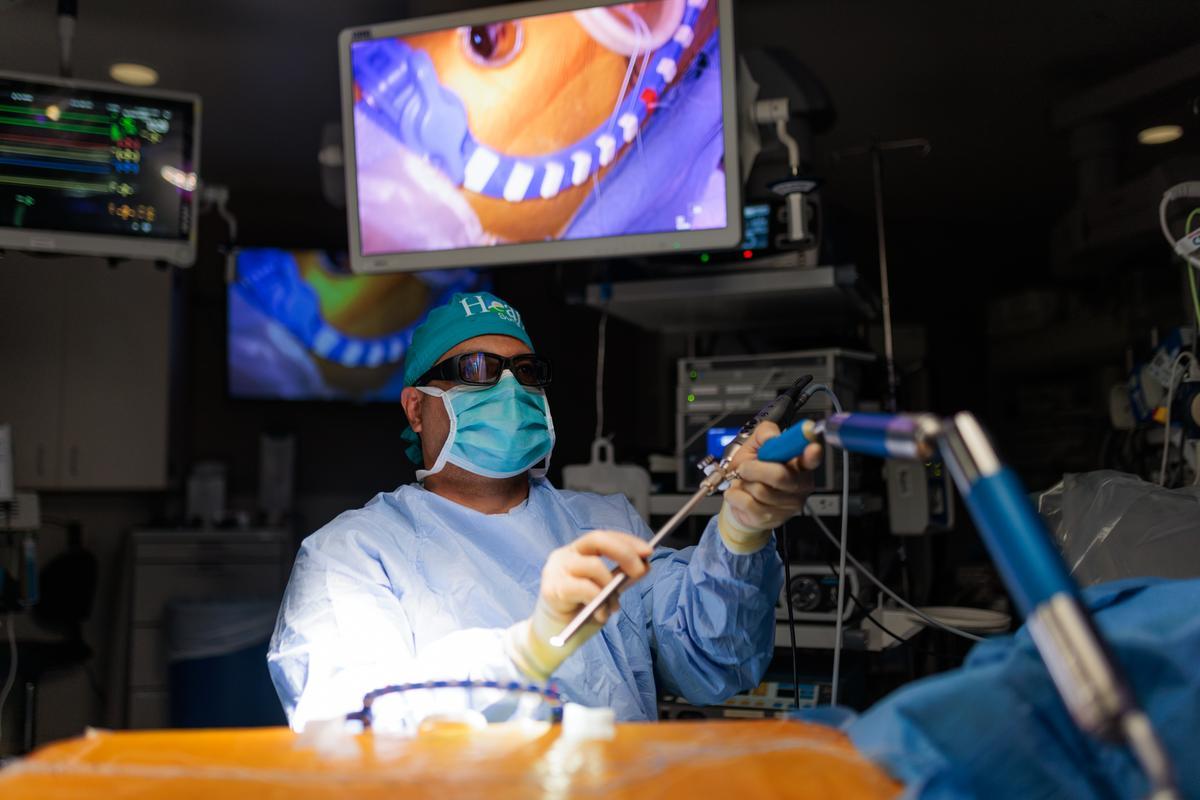
The term “totally endoscopic” refers to a surgical technique in which the entire procedure is performed by viewing a magnified image from a tiny camera inserted through a 2-2.5cm incision located between the ribs along the left side of the torso.
Every movement is performed manually by the surgeon at the operating table using long, slender instruments inserted through the tiny incision. These tools are customized for endoscopic access and require exceptional dexterity and spatial awareness. The surgeon performs intricate repairs while watching a monitor in real time – often suturing delicate valve tissue or navigating complex anatomy with millimeter-level precision.
The thoracic wall remains intact throughout the procedure. There is no bone disruption, no rib spreading and no need for a sternotomy. This approach preserves musculoskeletal integrity and minimizes trauma to surrounding structures – contributing to faster recovery and reduced postoperative discomfort.
Totally endoscopic cardiac surgery demands extensive experience and a rare level of technical skill, combining advanced imaging, microsurgical technique and deep familiarity with cardiac anatomy.
Tremendous Vision: See Better, Do Better
Our cardiac surgery team uses groundbreaking 3D 4K imaging for an unparalleled view of the operative field – enhancing clarity and depth perception. St. Elizabeth is among the first in the country to invest in a state-of-the-art 3D 4K Endoscope. This pioneering equipment takes TECS to the next level, offering a natural immersive view that provides unparalleled depth perception, greater accuracy and faster surgery.
This enhanced visualization allows us to do more with less – less trauma, less recovery time and less risk.
Watch & Learn: Join Dr. Castillo-Sang as he explains how this innovative technique works, who it’s for and why it’s changing the future of heart surgery.
Procedures performed with TECS
TECS is ideal for most heart conditions, including:
- Mitral valve repair or replacement – including degenerative prolapse
- Aortic and tricuspid valve surgeries
- Atrial septal defect (ASD) closure
- Barlow’s mitral valve repair
- Cardiac tumor removal – including myxomas
- Complex cases like mitral annular calcification
- Atrial fibrillation (AFib) ablation – often combined with valve repair
- Select structural heart repairs – including congenital anomalies
Inside the Procedure
The Revolutionizing Recovery Advantage
Choosing Totally Endoscopic Cardiac Surgery (TECS) unlocks the full potential of minimally invasive heart surgery. Because TECS avoids bone disruption and rib spreading, patients often experience a faster, less painful and more mobile recovery compared to traditional open-heart surgery.
| Benefit | TECS Difference |
|---|---|
| Incision Size | Minimal Scarring: Small 2-2.5cm incision between the ribs on the right side of the chest. |
| Hospital Stay | 30–50% Shorter Stay: TECS patients typically stay 2–3 days in the hospital vs. 5–7 days for sternotomy-based open-heart surgery. |
| Pain Level | Significantly Reduced Pain: TECS patients report lower pain scores starting on post-op day 2 and often require only non-opioid medications like Tylenol. |
| Recovery Time | Up to 50% Faster: Most TECS patients resume normal activities within 2–3 weeks, compared to 6–12 weeks for traditional open-heart surgery. |
| Restrictions | No Sternal Precautions: Because the sternum remains intact, patients avoid lifting and movement restrictions common after sternotomy. |
What Should I Ask My Surgeon?
If you’re considering Totally Endoscopic Cardiac Surgery, here are important questions to ask during your consultation — designed to help you understand your surgeon’s experience, approach and how the procedure will be tailored to you:
Frequently Asked Questions
Ask About the Technique – Not Just the Procedure
If your care plan includes heart surgery, it’s okay not to know every detail – but it’s important to thoroughly understand your condition and your treatment options. Ask your surgeon whether totally endoscopic cardiac surgery is appropriate for your case.
Call (859) 301-9010 to schedule a consultation with one of our cardiac surgeons.