

Welcome to Healthy Headlines—where care meets clarity and every article brings you closer to better health. Whether you’re looking for expert insights, patient stories or seasonal wellness tips, it's all right here—designed to guide you to the right care at the right time.
Part 1: Minimally Invasive vs. Truly Minimal
January 27, 2026
Decoding the Difference in Cardiac Surgery
The world of heart surgery is constantly advancing, driven by the quest for smaller incisisons, fast recoveries and better outcomes. Today, minimally invasive surgery is considered the gold standard across many disciplines, from orthopaedics to cardiology.
But here is a crucial distinction that most people – even those following medical trends – don’t realize: “minimally invasive” is a broad term. In cardiac surgery, the procedures covered by this general label vary dramatically and understanding the difference between claims of a smaller cut and a truly minimal approach like Totally Endoscopic Cardiac Surgery (TECS) is essential for appreciating the cutting edge of surgical innovation.
The Spectrum of Small Incisions
For decades, accessing the heart required splitting the entire breastbone (sternum) – a highly effective, but physically traumatic procedure. Minimally invasive techniques were developed specifically to bypass this necessity. But the term ‘minimally invasive’ can be misleading to patients.
Minimally invasive heart surgery encompasses a wide spectrum of approaches. The size of the incision is only part of the story. What truly matters is the severity of the trauma beneath the surface.
Here’s a look at the different methods used when avoiding a full sternotomy:
- Hemi-Sternotomy: This involves a smaller vertical incision, typically 3 to 4 inches, on the chest. While smaller, it still requires partial division of the breastbone to gain adequate access to the surgical field.
- Mini-Thoracotomy: This involves a smaller incision (around 3 inches) made on the side of the chest. It avoids the breastbone but often requires significant spreading of the ribs to create a stable viewing window for the surgeon.
- Totally Endoscopic Cardiac Surgery (TECS): A tiny < 1 inch (2.3 cm) incision is made in the soft tissue between the ribs on the side of the chest. Sometimes referred to as keyhole surgery, TECS is the most advanced and least invasive form of cardiac surgery available today.
Dr. Mario-Castillo-Sang, a Cardiac Surgeon at St. Elizabeth, emphasizes the distinction, “Our totally endoscopic approach is truly minimal. We’re able to successfully repair the heart and eliminate any structural damage to the chest wall or trauma to the ribs. It transforms the way patients heal – making recovery faster and far less restrictive.”
Less Trauma, More Healing
Heart surgery is more than a procedure; it’s a life-changing moment. TECS makes that moment gentler by protecting what matters most: your body’s natural foundation. No broken bones, no rib strain – just a precise, advanced approach that helps you heal with less pain and more confidence. This isn’t just surgery; it’s a way forward that puts your comfort and recovery first.
Take a closer look at how each approach impacts your body – and why TECS makes such a big difference.
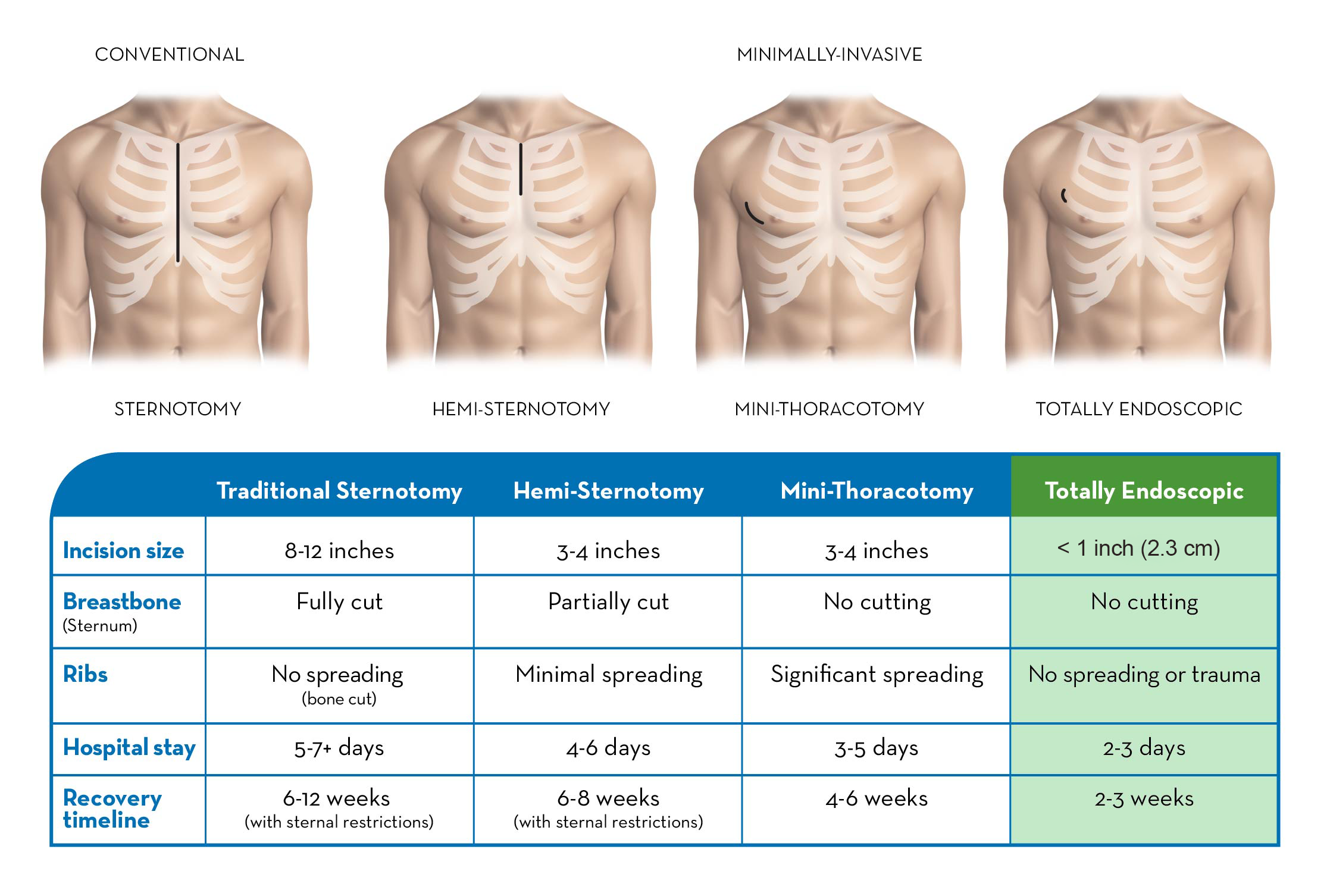
In the next part of this series, we will look behind the small incision and explore how surgeons can achieve such precision using a tiny incision, focusing on the role of 3D 4K endoscopic technology.
Want to Learn More?
If you or a loved one are facing heart surgery, ask your doctor about TECS. It’s not just minimally invasive – it’s maximally advanced. Visit our website to learn more about our Cardiac Surgery Program or call (859) 301-9010 to schedule a consultation with Dr. Castillo-Sang or another member of our team.
Catch up on the series: You just read Part 1 of 6.
Read Introduction: Is Your “Minimally Invasive” Surgery Truly Minimal?
Up Next: Part 2: Beyond the Naked Eye: How 3D Visualization Enhances Surgical Precision
Medically reviewed by Mario Castillo-Sang, MD, on 12/31/2025.
Related Posts
Stay in the Know
Helping you live a better life – that’s the goal of Healthy Headlines. Subscribe to our monthly newsletter for content delivered straight to your inbox.
By submitting this form, you are consenting to receive marketing emails from: St. Elizabeth, 1 Medical Village Drive, Edgewood, KY, 41017, US, https://www.stelizabeth.com. You can revoke your consent to receive emails at any time by using the SafeUnsubscribe® link, found at the bottom of every email. Emails are serviced by Constant Contact.

Free Language Assistance Available:
عربي | 中国人 | Dansk | Nederlands | English | Soomaali | Français | Deutsch | Norsk Bokmal | Español | Svenska
© 2026 St. Elizabeth Healthcare. All rights reserved. St. Elizabeth Healthcare is a registered 501(c)(3) non-profit corporation serving the Northern Kentucky/Greater Cincinnati region. Tax identification #610445850