

Welcome to Healthy Headlines—where care meets clarity and every article brings you closer to better health. Whether you’re looking for expert insights, patient stories or seasonal wellness tips, it's all right here—designed to guide you to the right care at the right time.
AFib and Stroke: What You Need to Know
September 3, 2026
Summary Paragraph
Many people only think of atrial fibrillation (AFib) as being a heart rhythm problem. While that’s true, one of the biggest concerns about AFib is its connection to stroke.
The good news is that there are treatments available to help reduce that risk. Understanding the relationship between AFib and stroke is an important step toward protecting your long-term health.
“One of the most important things patients should understand about AFib is that it doesn’t just affect how the heart beats,” says Dr. Mohamad Sinno, an Electrophysiologist at St. Elizabeth. “It can also increase the risk of stroke, which is one of the reasons why early diagnosis and appropriate treatment are so important.”
Key Takeaways
- AFib can increase stroke risk because irregular heartbeats may allow blood to pool and form clots.
- Some people with AFib have mild symptoms or no symptoms at all.
- Treatment may include medication, heart rhythm management, lifestyle changes or procedures such as WATCHMAN™ or catheter ablation.
- Your stroke risk is personal, so it is important to talk with your healthcare provider about your options.
What Is AFib?
AFib is the most common heart rhythm disorder. It occurs when the upper chambers of the heart beat irregularly and out of sync with the lower chambers.
Some people experience symptoms such as:
- Heart palpitations
- Fatigue
- Shortness of breath
- Dizziness
Others may have mild symptoms or none at all.
Whether symptoms are present or not, AFib can increase the risk of serious complications if left untreated.
How Does AFib Increase Stroke Risk?
In a normal heartbeat, blood moves efficiently through the heart.
With AFib, the upper chambers don’t contract as effectively as they should. Instead, they quiver or beat irregularly. This can allow blood to pool inside the heart.
When blood stays in one place for too long, clots can form.
If a clot leaves the heart and travels to the brain, it can block blood flow and cause a stroke.
“AFib increases stroke risk because blood doesn’t move through the heart as efficiently as it should,” explains Dr. Sinno. “When blood sits in one place for too long, clots can develop, and those clots can potentially travel to the brain.”
Can You Be at Risk Even Without Symptoms?
Yes. One of the challenges with AFib is that not everyone experiences obvious symptoms. Some people don’t realize they have AFib until it is discovered during a routine exam, after a smartwatch alert or while being evaluated for another condition.
Not having symptoms does not always mean there is no risk.
That’s one reason healthcare providers take AFib seriously, even when it isn’t causing noticeable symptoms.
How Is Stroke Risk Reduced?
Treatment plans are individualized, but reducing stroke risk is one of the primary goals of AFib management.
Depending on a person’s age, medical history and overall health, treatment may include:
- Medications to reduce clot formation.
- Heart rhythm or heart rate management.
- Lifestyle modifications.
- Medical procedures to lower stroke risk.
Your healthcare provider can help determine the most appropriate option based on your individual risk factors.
What If Blood Thinners Aren’t Right for You?
Many people with AFib take blood thinners, also called anticoagulants, to help reduce stroke risk. But blood thinners are not the right long-term option for everyone.
Some people have:
- A history of bleeding.
- Difficulty tolerating blood thinners.
- Other medical considerations that make long-term use challenging.
For some people, other treatment options may be available.
What Is the WATCHMAN™ Procedure?
The WATCHMAN™ procedure is designed for certain people with AFib who are looking for an alternative to long-term blood thinner therapy. The device is placed in a small area of the heart called the left atrial appendage, where many AFib-related blood clots can begin.
By closing off that area, the procedure can help reduce stroke risk.
Not every person with AFib is a candidate for the WATCHMAN, so it’s important to discuss the benefits and risks with your healthcare provider.
For additional information about the WATCHMAN, view Boston Scientific’s video.
What Is AFib Ablation?
For many people, AFib care involves more than reducing stroke risk. Treatment may also focus on controlling or eliminating the abnormal electrical signals that cause the heart to beat irregularly through a minimally invasive procedure.
During a catheter ablation procedure, an electrophysiologist targets small areas of heart tissue responsible for triggering or sustaining AFib. The goal is to reduce symptoms, improve quality of life and help maintain a normal heart rhythm.
Not every person with AFib requires ablation, but it can be an effective treatment option for select individuals. A cardiac electrophysiologist can evaluate your symptoms, medical history and treatment goals to determine whether ablation may be appropriate.
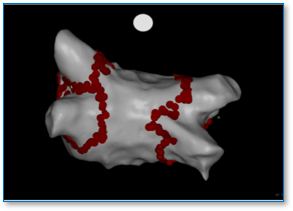
Example of an AFib Ablation Map Provided by Mohamad Sinno, MD
The red areas show where treatment was delivered to help restore a more normal heart rhythm.
What Should You Do If You Have AFib?
The most important thing is to stay engaged with your care plan.
That may include:
- Taking medications as prescribed.
- Keeping follow-up appointments.
- Managing other health conditions.
- Asking questions about stroke risk and treatment options.
If you’ve been diagnosed with AFib and aren’t sure how it affects your stroke risk, bring that conversation to your next appointment. Understanding your personal risk can help you make informed decisions about your care.
Protecting Your Heart Starts with Understanding Your Risk
AFib and stroke are closely connected, but a diagnosis of AFib does not mean a stroke is inevitable.
With appropriate treatment, ongoing monitoring and a personalized care plan, many people with AFib live full and active lives while successfully managing their risk.
The key is knowing about the condition, understanding your options and taking steps to address it before complications occur.
Start the Conversation with Your Care Team
If you have AFib, you do not have to navigate your stroke risk alone. Your care team can help you understand your personal risk and which treatment options may be right for you.
Start by discussing your concerns with your primary care provider. Depending on your diagnosis and treatment goals, your care team may recommend referral to a cardiologist or cardiac electrophysiologist for additional evaluation.
For questions about AFib and available treatment options, call (859) 331-3353 to speak with an Arrhythmia Center Nurse Navigator.
Medically reviewed by Mohamad Sinno, MD, on 8/13/2026.
Accepting New Patients

Mohamad Sinno, MD
Clinical Cardiac Electrophysiology, Cardiovascular Disease
Clinical Focuses: Cardiovascular Disease, Atrial Fibrillation, Electrophysiology(View All)

Make an Appointment
Call Us
(859) 331-3353Video visits limited to existing patients. Login to MyChart to schedule or call.
Practice Location View
St. Elizabeth Healthcare
Arrhythmia Consultants - HVI Edgewood Heart & Vascular Institute
711 Medical Village Drive, Edgewood, KY 41017-3439
Get DirectionsRelated Posts
Stay in the Know
Helping you live a better life – that’s the goal of Healthy Headlines. Subscribe to our monthly newsletter for content delivered straight to your inbox.
By submitting this form, you are consenting to receive marketing emails from: St. Elizabeth, 1 Medical Village Drive, Edgewood, KY, 41017, US, https://www.stelizabeth.com. You can revoke your consent to receive emails at any time by using the SafeUnsubscribe® link, found at the bottom of every email. Emails are serviced by Constant Contact.


Free Language Assistance Available:
عربي | 中国人 | Dansk | Nederlands | English | Soomaali | Français | Deutsch | Norsk Bokmal | Español | Svenska
© 2026 St. Elizabeth Healthcare. All rights reserved. St. Elizabeth Healthcare is a registered 501(c)(3) non-profit corporation serving the Northern Kentucky/Greater Cincinnati region. Tax identification #610445850